Enterprise ready tools to accelerate YOUR SAP SDLC for faster, smoother, and efficient delivery
SASA Features
Core Capabilities of the SASA Platform
SASA (SAP AI SDLC Assist) is an AI-powered platform built to significantly reduce delivery time, operational cost, and execution risk across the SAP software development lifecycle—spanning ECC, S/4HANA, and SAP BTP. By combining generative AI, agentic automation, and SAP-specific intelligence, SASA automates high-effort activities such as documentation, development, testing, integration, and migration.
Powered by AiFA Labs' Cerebro platform, SASA acts as an intelligent operating layer for SAP engineering, enabling automation at scale across functional, technical, and integration workstreams, and helping organizations achieve predictable delivery, lower risk, and sustained productivity gains.
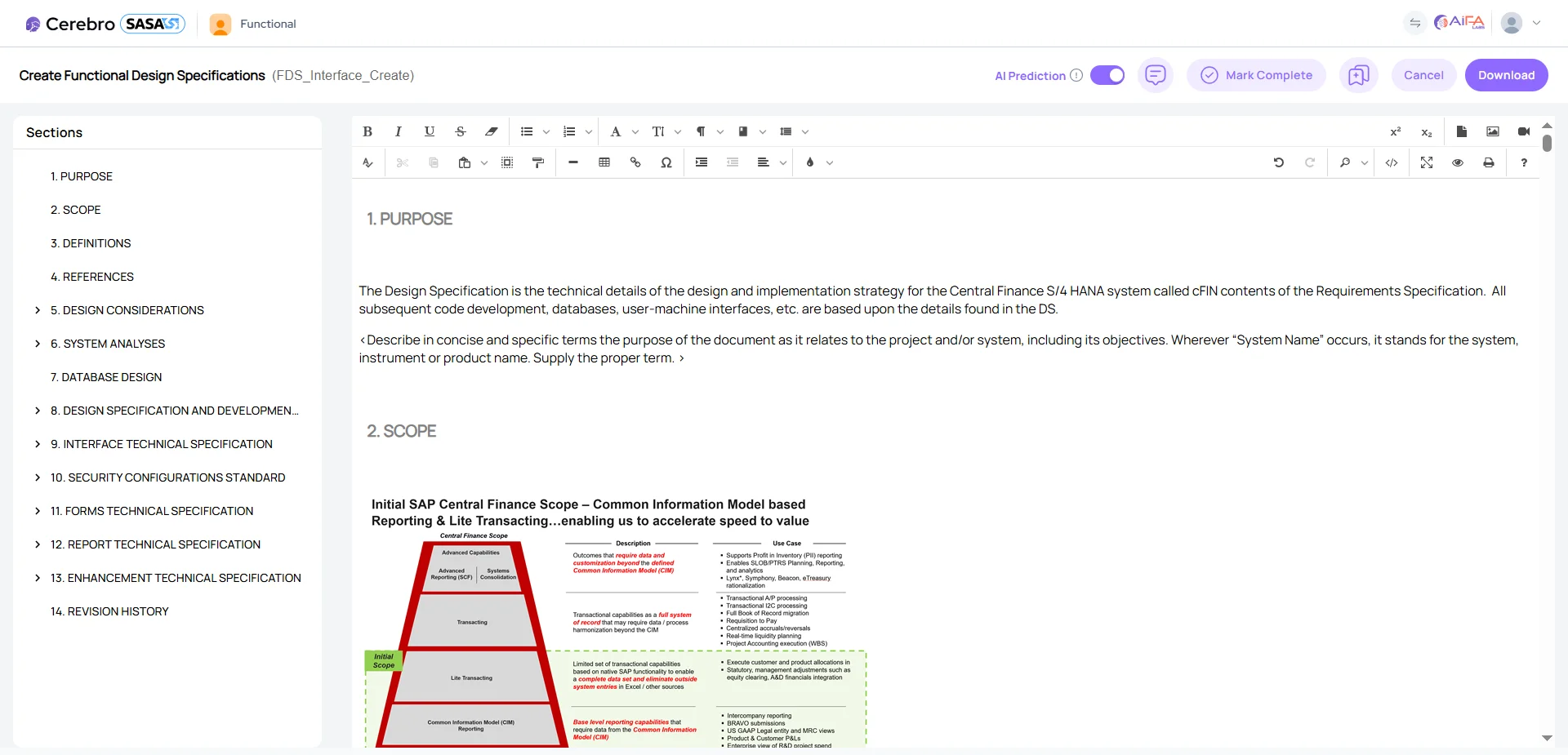
Functional Design Specification (FDS) Creation
SASA automatically converts BRDs into complete, SAP WRICEF-aligned FDS documents using advanced AI. It supports SAP-standard or client-specific templates, highlights AI-generated sections, predicts next-line functional logic, and offers SAP domain assistance through an integrated chatbot. The output is a polished, editable, audit-ready Word document.
Key Benefits:
Reduces FDS creation time by up to 30%.
Ensures consistent, high-quality documentation.
Minimizes requirement gaps and rework.
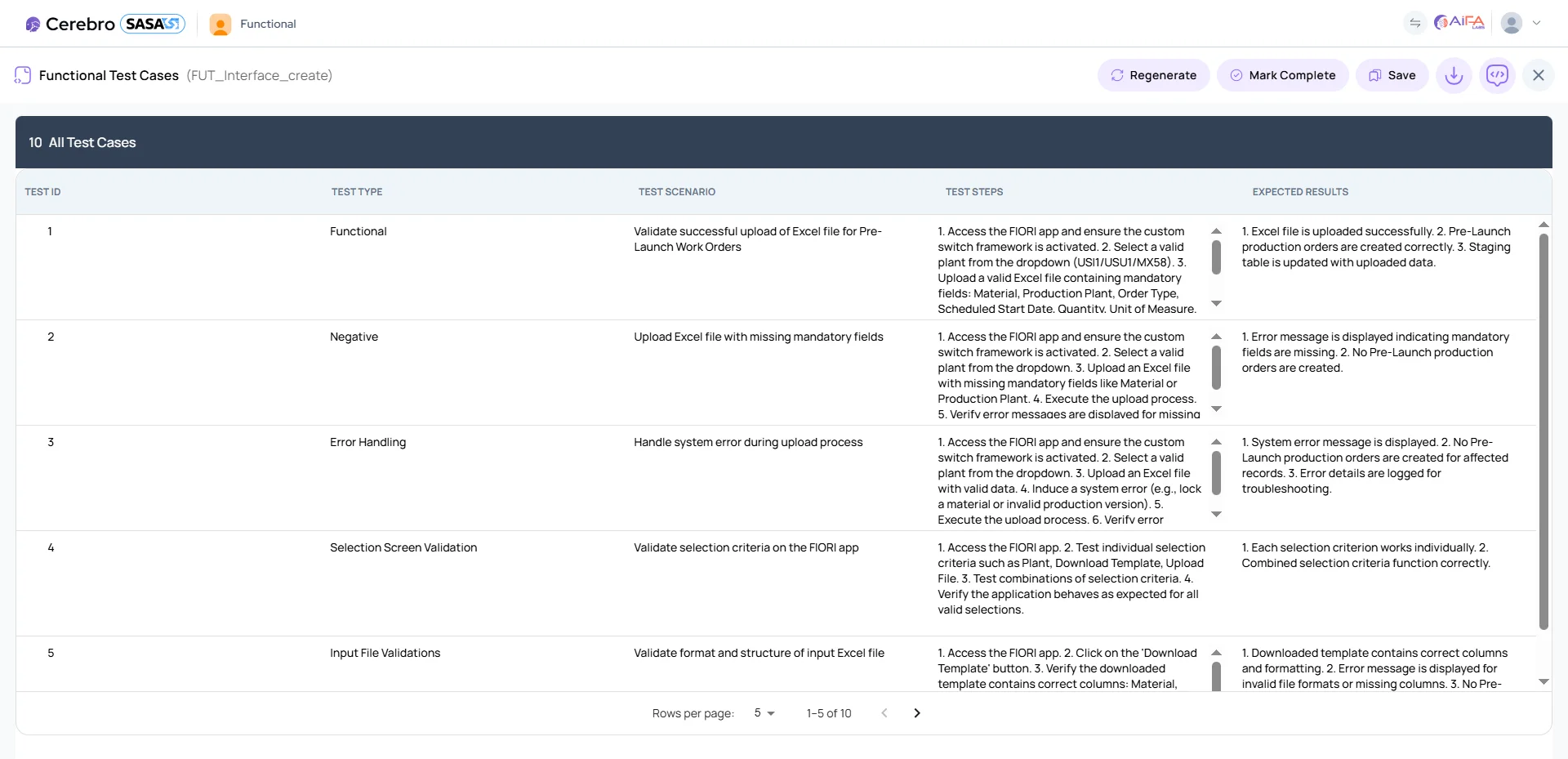
Functional Unit Test (FUT) Creation
SASA auto-generates FUT test cases directly from the FDS, producing scenario descriptions, IDs, steps, and expected results using SAP-aligned templates. It supports intelligent regeneration of sections, provides testing guidance through a functional chatbot, and exports documentation in Word or Excel.
Key Benefits:
Ensures complete alignment with the FDS.
Cuts manual test documentation effort by 30%.
Strengthens early QA and UAT readiness.
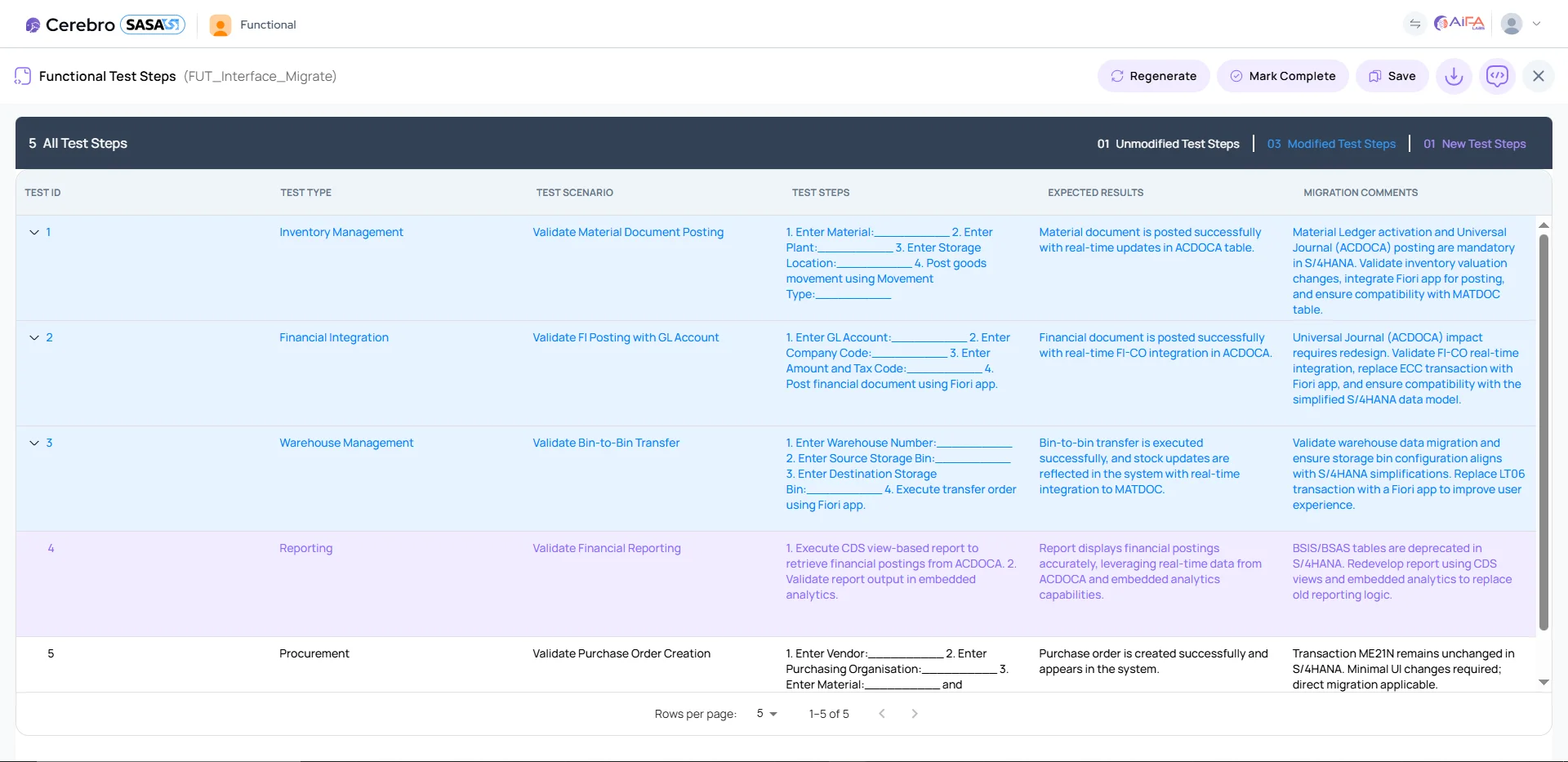
Functional Unit Test (FUT) Migration
SASA accelerates migration of existing FUT test cases during upgrades by identifying unchanged, updated, and missing scenarios. It offers side-by-side comparisons, impact insights, and migration quality assessments to ensure comprehensive test continuity.
Key Benefits:
Reduces migration effort and prevents missed scenarios.
Ensures test consistency across system upgrades.
Shortens upgrade and testing cycles.
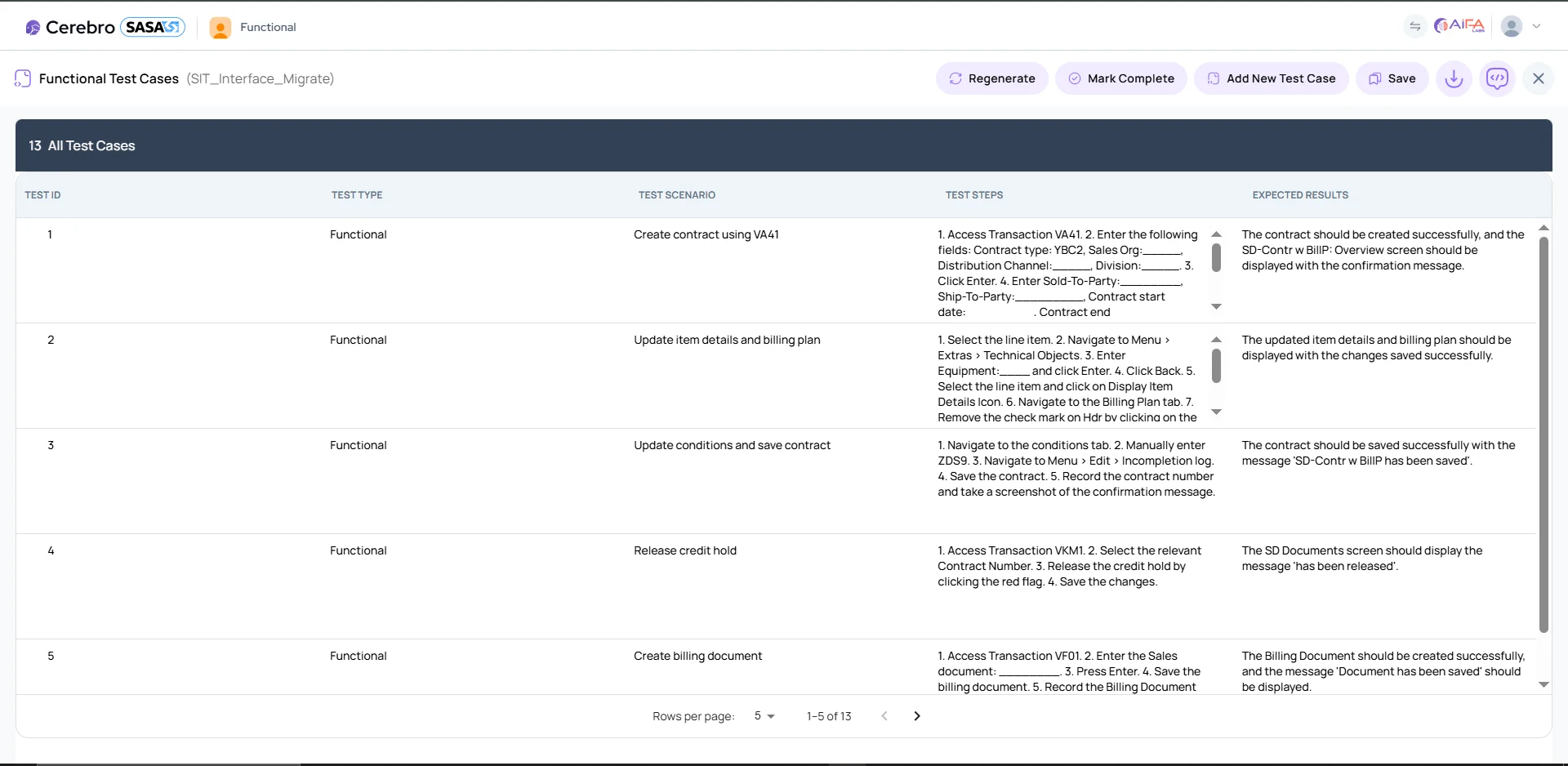
System Integration Test (SIT) Migration
SASA automates SIT test case updates by analyzing new requirements and system changes. It highlights integration flow differences, regenerates impacted scenarios, and uses an AI chatbot to guide users through complex SAP module dependencies.
Key Benefits:
Simplifies multi-module SAP integration testing.
Cuts SIT preparation and review time.
Ensures integration flows remain accurate and up-to-date.
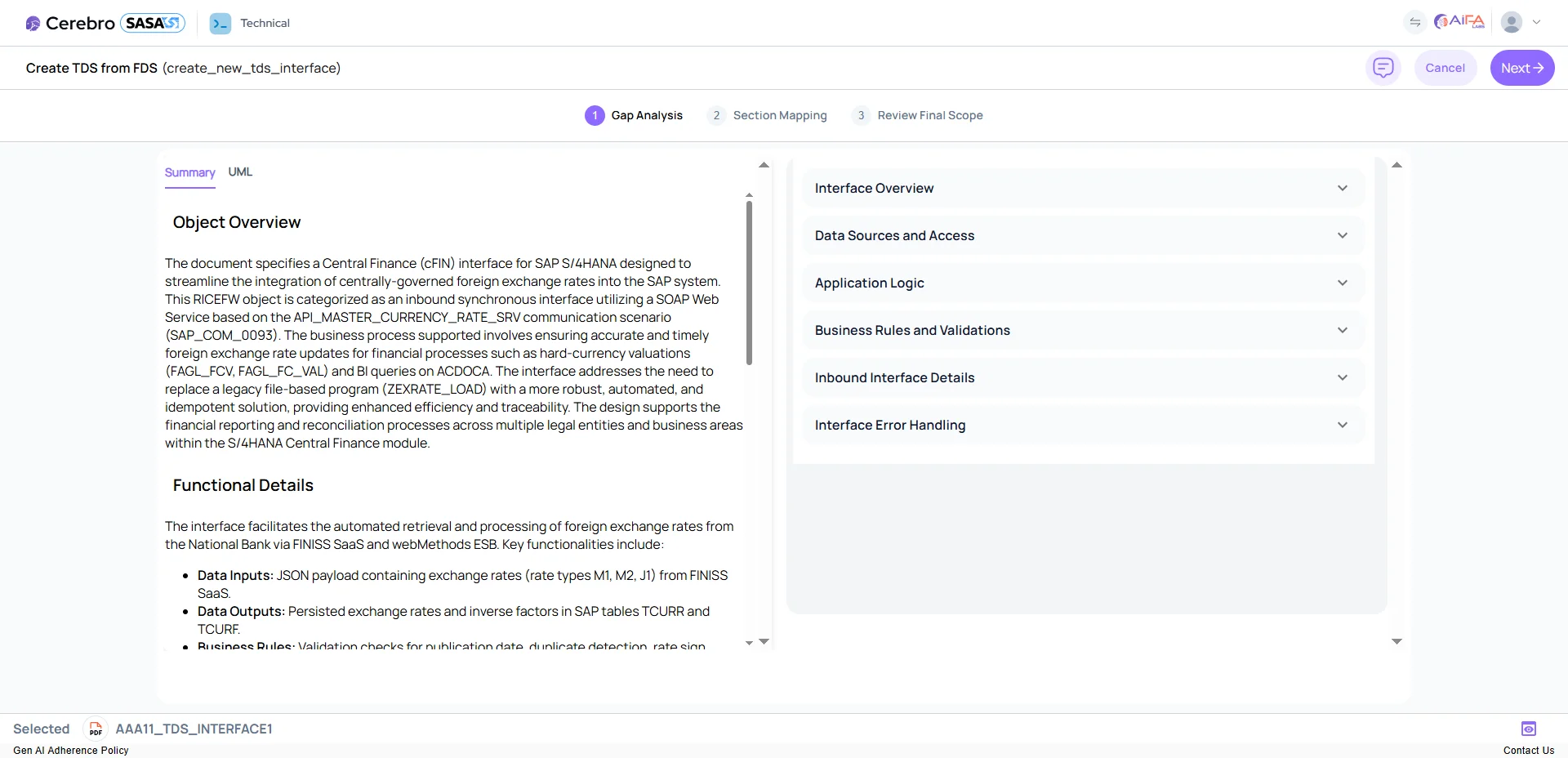
Technical Design Specification (TDS) Generation
SASA converts functional specifications into complete technical designs by extracting technical objects, generating data models, UML diagrams, validation rules, and flow sequences. It allows selective regeneration, provides SAP technical clarification via chatbot, and outputs fully formatted Word documents.
Key Benefits:
Bridges functional-to-technical gaps with precise documentation.
Reduces rework and accelerates development kickoff.
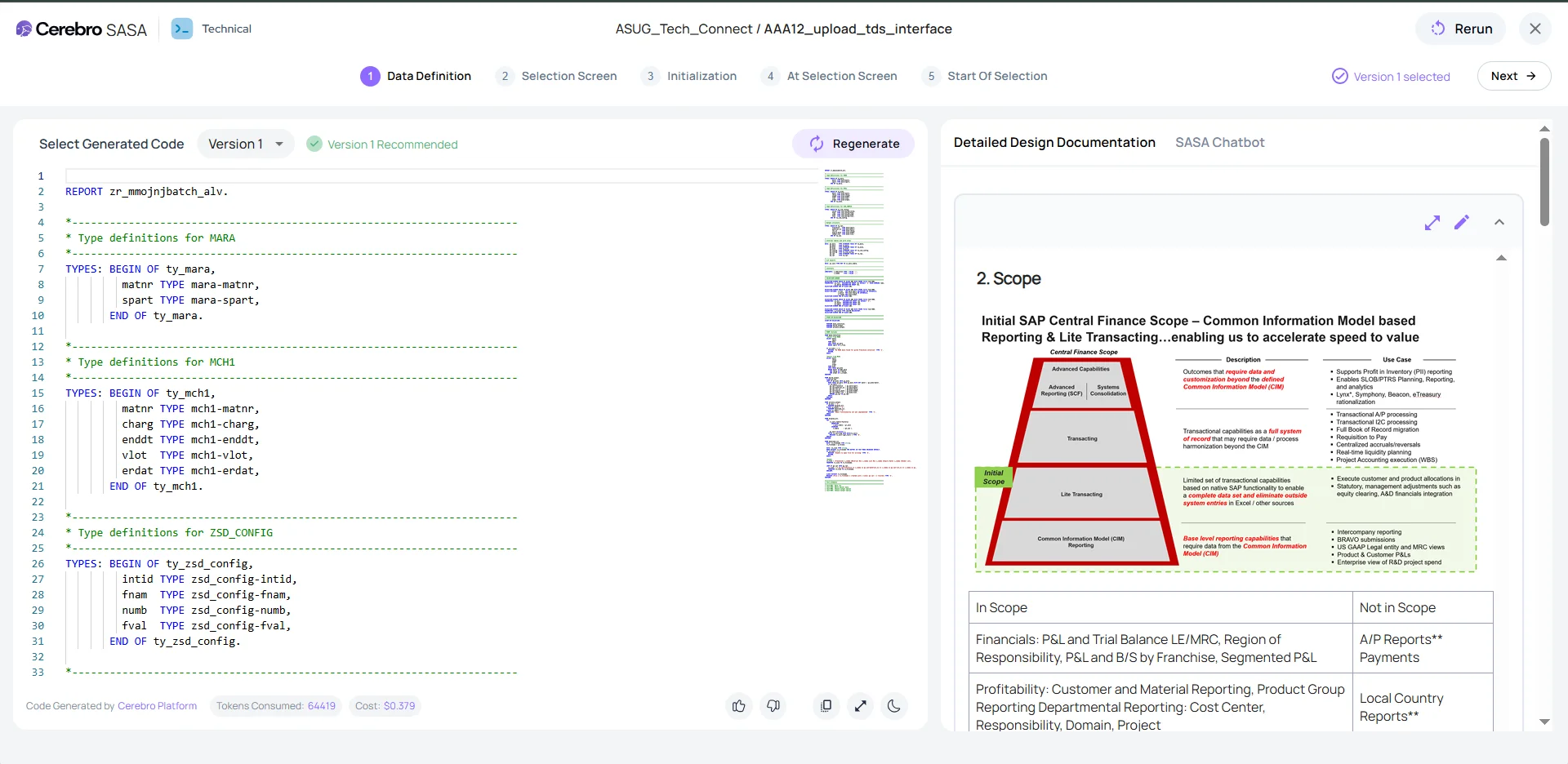
SASA generates clean, optimized ABAP code from TDS documents, offering multiple code versions, automated syntax fixes, logical corrections, and AI-driven performance reviews. Developers can refine, compare, and regenerate code with ease using guided AI assistance.
Key Benefits:
Cuts development time by up to 50%.
Ensures maintainable, SAP-standard ABAP code.
Reduces defects early through automated code review.
Technical Unit Test (TUT) Generation
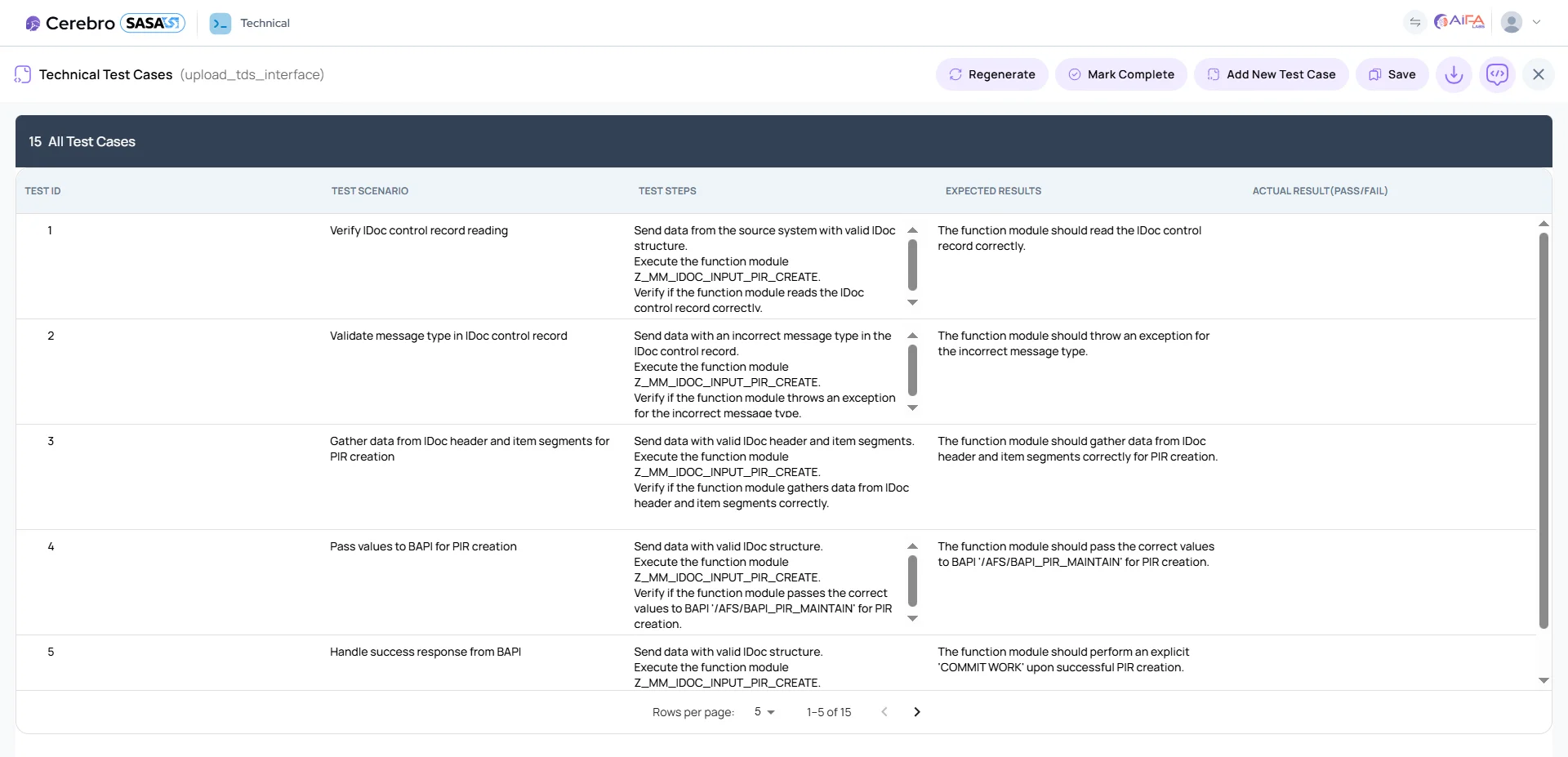
SASA auto-creates comprehensive TUT documentation aligned with generated code, producing ~15 test cases per object with IDs, steps, expected results, and editable logic. Output is available in Word or Excel, with chatbot guidance for test validation.
Key Benefits:
Ensures strong unit test coverage instantly.
Reduces production defects with structured testing.
Improves auditability and traceability.
Design Document Quality Checker
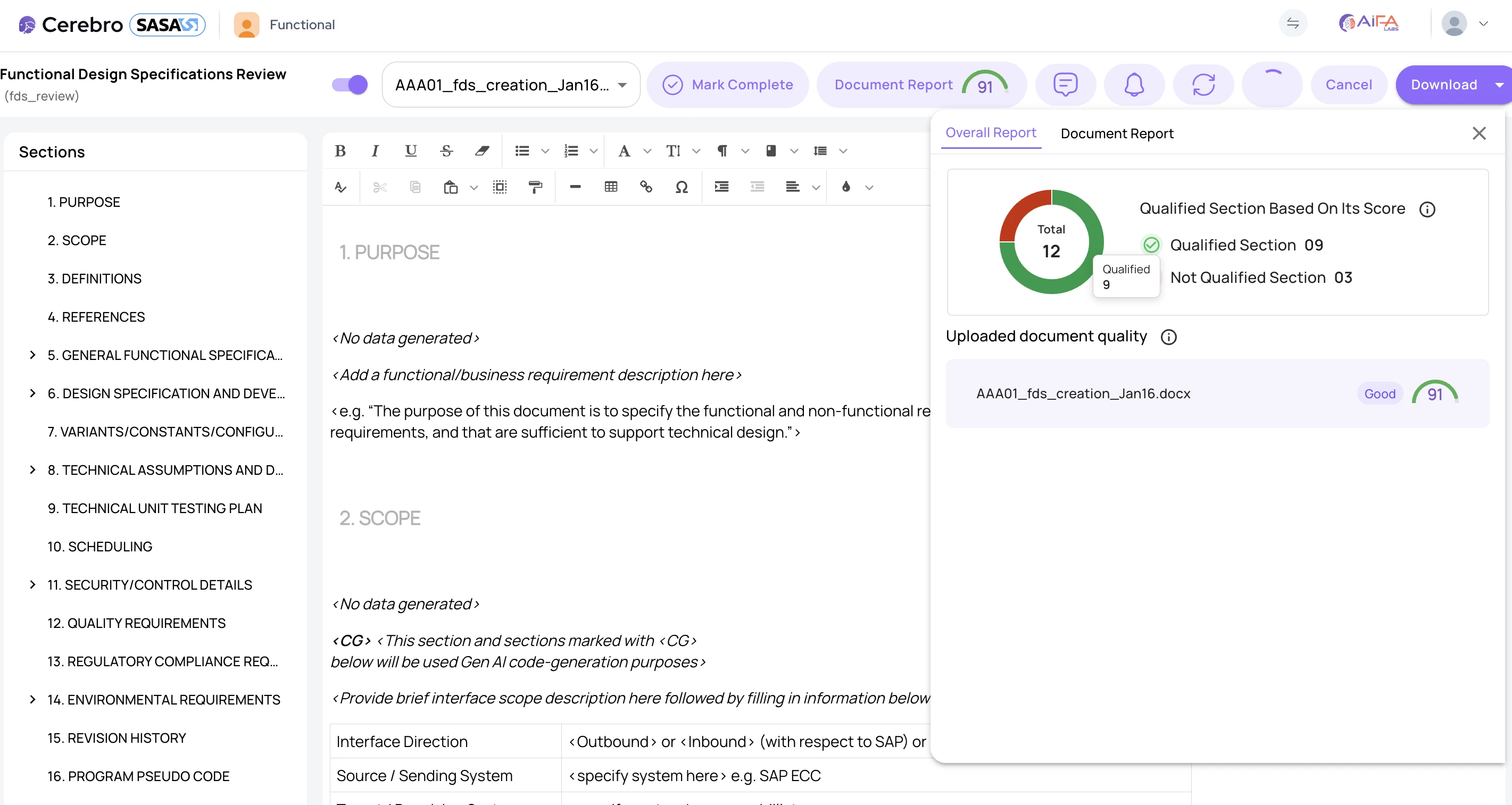
SASA reviews the completeness, consistency, & relevance of TDS & FDS, providing an overall quality score and detailed breakdown of customizable mandatory sections. It highlights missing elements such as diagrams, tables, sections, or misaligned content across the document.
Key Benefits:
Instant Quality Insights – Get an overall score and section-level breakdown for clarity.
Customizable Standards – Define mandatory sections and let the tool learn YOUR requirements.
Continuous Improvement – Update documents and recalculate scores to maintain top quality.
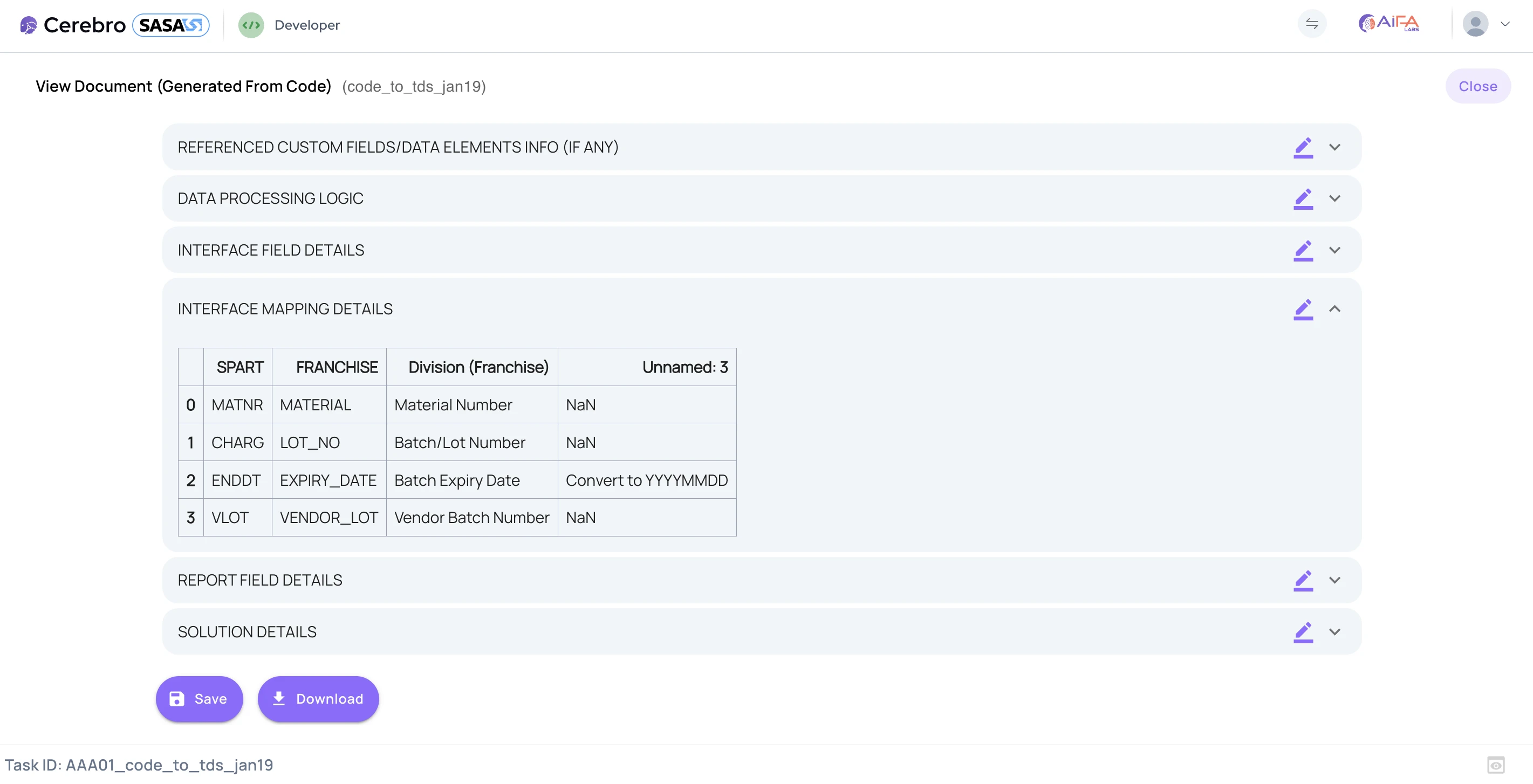
ABAP Code to Technical Specification Document
The ABAP Code to Technical Specification Tool automatically analyzes your ABAP code and converts it into a structured, ready to use technical specification. It extracts logic, workflows, and dependencies to streamline documentation and eliminate manual effort.
Key Benefits:
Automated documentation – instantly generates technical specs from existing ABAP code, saving hours of manual writing.
Clear, Consistent Structure – produces standardized documents that match your team’s preferred format and detail level.
Better Knowledge Transfer – translates complex code into easy to understand documentation for developers, testers, and functional teams.
How Roles Shape the Platform
Each persona represents a distinct function within the platform, from administration to daily operations. By assigning clear boundaries and capabilities, the system supports better governance, smoother collaboration, and consistent execution across teams.
Admin Persona
The Admin Persona gives teams full control over how the customizable platform is configured and governed. Admins can easily manage LLM connections, set usage limits, configure databases, and define project structures and templates. A centralized dashboard provides visibility into productivity, cost, and system activity for compliance and troubleshooting.
Accelerates SAP Technical development workflow.
Reduces defects through AI-driven review and testing.
Maintain consistent technical standards across projects.
Technical Persona
Technical Persona provides AI-driven TDS creation, ABAP code generation, TUT creation, and technical validation. It supports template compliance checks, code regeneration, bug fixing, and documentation refinement through SASA Write.
Reduces defects through AI-driven review and testing.
Accelerates SAP technical development workflows.
Maintains consistent technical standards across projects.
Functional Persona
Functional Persona enables users to create FDS documents, auto-generate FUT/SIT test cases, navigate RICEFW objects, validate with Clean Core and AI scoring, and refine content using SASA Write. All outputs are downloadable in ready-review formats.
Speeds up testing preparation and reduces manual effort.
Ensures accurate requirement documentation.
Delivers full traceability across objects and artifacts.
Developer Persona
Developer Persona enables developers to generate, refine, debug, and optimize ABAP code with AI assistance. It supports code comparison, auto-fix, regeneration, and immediate access to TUT documentation for validation.
Reduces rework with structured workflows and AI guidance.
Migrator Persona
Migrator Persona automates creation of migration specifications, mappings, validation rules, and test cases. By uploading legacy files, users get instantly generated transformations, checks, and documentation with AI validation.